What happens when you inadvertently unearth an ancient, alien civilization in a frozen Antarctic Mountain expanse? If H.P. Lovecraft has anything to do with it, madness will surely ensue. Thus, his aptly titled “At the Mountains of Madness” (hereafter referred to as ATMOM). Despite the fact that this is perhaps my all-time favorite horror story, not everyone holds the tale in such high esteem. On numerous occasions I’ve been confronted with quizzical responses or even scornful reproach from folks after reading the story on my recommendation.
To be fair, ATMOM is flawed. Originally submitted for publication to Weird Tales in July of 1931, the story was rejected, which rankled Lovecraft. ATMOM wasn’t officially published until 1936, when it was serialized in the February, March, and April editions of Astounding Stories. Even so, it was heavily edited and had major omissions. This further rankled Lovecraft, who may have considered it his penultimate work of fiction. With this in mind, allow me to present a basic synopsis of the story and share my perspective on its strengths and weaknesses. I’m sure it will come as no surprise that, in the end, I will stand by my assertion of ATMOM as a major classic which you, fearless reader, are free to agree or disagree with.
The story begins under the auspices of an Antarctic expedition to test the efficacy of a new experimental drill. Three cheers for science, technology, and the plunder of unspoiled lands! Anywho, things take a turn for the strange when a remote advance team unearths a cave using the aforementioned drill. Radioing back to expedition leader Dr. William Dyer at base camp, they also report the discovery of fossilized remains of lifeforms entirely unknown to science. Like, really bizarre. We’re talking about barrel shaped creatures with star-like heads and massive batwings. I know, right? This discovery is poised to turn the evolutionary history and biology of our entire planet on its proverbial head! Suddenly, that newfangled drill isn’t such a big deal. But things turn dire when contact is mysteriously lost with the remote team. Now, that’s a real chin scratcher. A rescue party is hastily assembled, headed by the stalwart Dr. William Dyer himself. Off they fly in one of their specially designed Antarctic airplanes. The wreckage of their comrade’s camp along with gruesome slaughter of all but one missing team member (Gedney) is what Dyer and company discover. Oh, and those bizarre fossils they heard about … several of them are missing as well … almost like they weren’t really fossils at all but perhaps … no, no, it’s too terrible to contemplate. The only rational explanation is the poor Gedney went mad and killed everyone, packed up those fossils, and made for the nearby mountains. Sure, that makes sense.
So, we’re off again, flying toward the imposing mountain range to hopefully find Gedney and get this whole untidy affair sorted out. After all, there are major scientific discoveries at stake. We don’t want to muddy the waters with madness and mass murder, right?
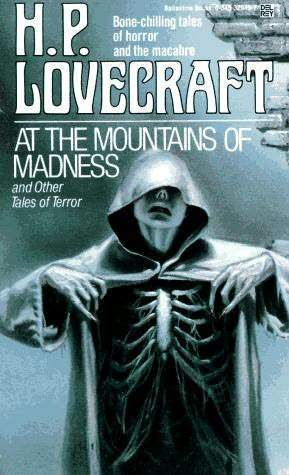
Now, in my opinion, this is where the story starts to lose people. For the purposes of brevity and in the interest of avoiding spoilers, allow me to nutshell it for you. In the mountains, Dyer and friends discover an ancient, seemingly dead civilization. The ruins they plumb predate human evolution and are clearly the province of a highly advanced and entirely different order of life (remember those barrel shaped star-headed fellows?). Referencing my old Del Ray paperback edition of ATMOM (printed in 1988), Lovecraft spends the next 47 pages providing exposition and description of the ruins. Nearly half of the novella. When you take into consideration Lovecraft’s depth of imagination and descriptive prowess, this can be a bit much for some readers. The action takes place entirely through Dyer’s exposition. Applying a rather slapdash blend of engineering, archaeology, and anthropology, Dyer and his companions are able to piece together the entire history of this uncanny race over what amounts to the course of an afternoon. It’s a bit much, and the reader is tempted to ask “Hey, didn’t you guys come here to test a drill?”
And yet, if you can hang in there and suspend your disbelief, there is potent magic at work in Lovecraft’s prose. He weaves another world out of his imagination, and one that inspires the most delightful sensation of dread (if you’re into that type of thing, and since you’re reading Lovecraft, I suspect you are). In the end, there is some action that takes place, for that seemingly dead civilization might not be as dead as we were initially led to believe. Very satisfying and worth the wait. To whet your appetite, let me inform you that there are oversized mutant penguins. I’ll spare you any further details to avoid giving anything away, but let it suffice to say that it drives one of Dyer’s companions completely over the edge of sanity.
What makes ATMOM great is the aforementioned dread that Lovecraft conjures. As badly as we want to learn the origin of the alien lifeforms and their civilization, we know there’s going to be a price to pay. And the further we go, the bigger we realize that price is going to be. It’s similar to Leahy’s “In Amundsen’s Tent”, but on a much grander scale. For it’s not just rousing some undescribed and inhuman entity from its slumber, it’s reawakening an entire fiendish race. And who knows what these chaps are going to do after realizing they’re sharing the planet with a bunch of puny humans?
This is a masterful use of the horror archetype I call “don’t go in there.” You see this used for better or worse in almost every horror movie. It’s done particularly well in Ridley Scott’s 1979 film Alien, which is widely considered to be heavily influenced by ATMOM. Lovecraft, perhaps better than anyone else, defines humanity’s place in the universe. And let’s just say we’re not in the upper echelon of who’s running the show. ATMOM clearly establishes not only our frailty as a species, but that it would be best if we keep our heads down and go unnoticed by some of the more dominant denizens of the universe.
If you’re still reading, thank you. I hope this little exposé has sparked some interest in ATMOM. While somewhat maligned, I can’t emphasize enough how much influence Lovecraft in general and ATMOM in specific have had on the evolution of the horror genre through the 20th and into the 21st centuries. Do yourself a favor and check it out. If you do, please reach out with any thoughts, comments, or even those damnable criticisms which I know you might very well have. Happy reading!